The Plumbing Job Isn’t Sold Until the Deposit Lands
The Plumbing Job Isn’t Sold Until the Deposit Lands A fast truck roll is not a sale. In plumbing, revenue starts leaking after the diagnosis when an estimate gets trapped in texts, inboxes, or an office queue. A...
The Plumbing Job Isn’t Sold Until the Deposit Lands
A fast truck roll is not a sale. In plumbing, revenue starts leaking after the diagnosis when an estimate gets trapped in texts, inboxes, or an office queue. A technician can identify the problem, explain the repair, and earn the customer’s trust onsite—then still lose momentum if the customer has to wait for a quote, a signature request, or a separate payment link.
That is the real cash-flow problem: not slow dispatch, but slow approval.
For plumbing companies, the strongest quote-to-cash workflow turns an onsite diagnosis into a clear customer-facing PDF, a quick e-signature, and a deposit payment opportunity while the problem still feels immediate. That is the difference between “we should get this done” and “the job is booked.” [Flash Quote Plumbing](https://apps.apple.com/us/app/flash-quote-plumbing/id6775365155) is designed to help plumbers turn the conversation at the kitchen table, utility closet, or commercial restroom into a document a customer can approve and pay from without waiting for another callback.
Urgency Has a Short Half-Life
Plumbing customers do not call because they enjoy comparing repair options. They call because water is where it should not be, a drain is backing up, a fixture has failed, or a water heater has gone cold.
That urgency is real. It is also fragile.
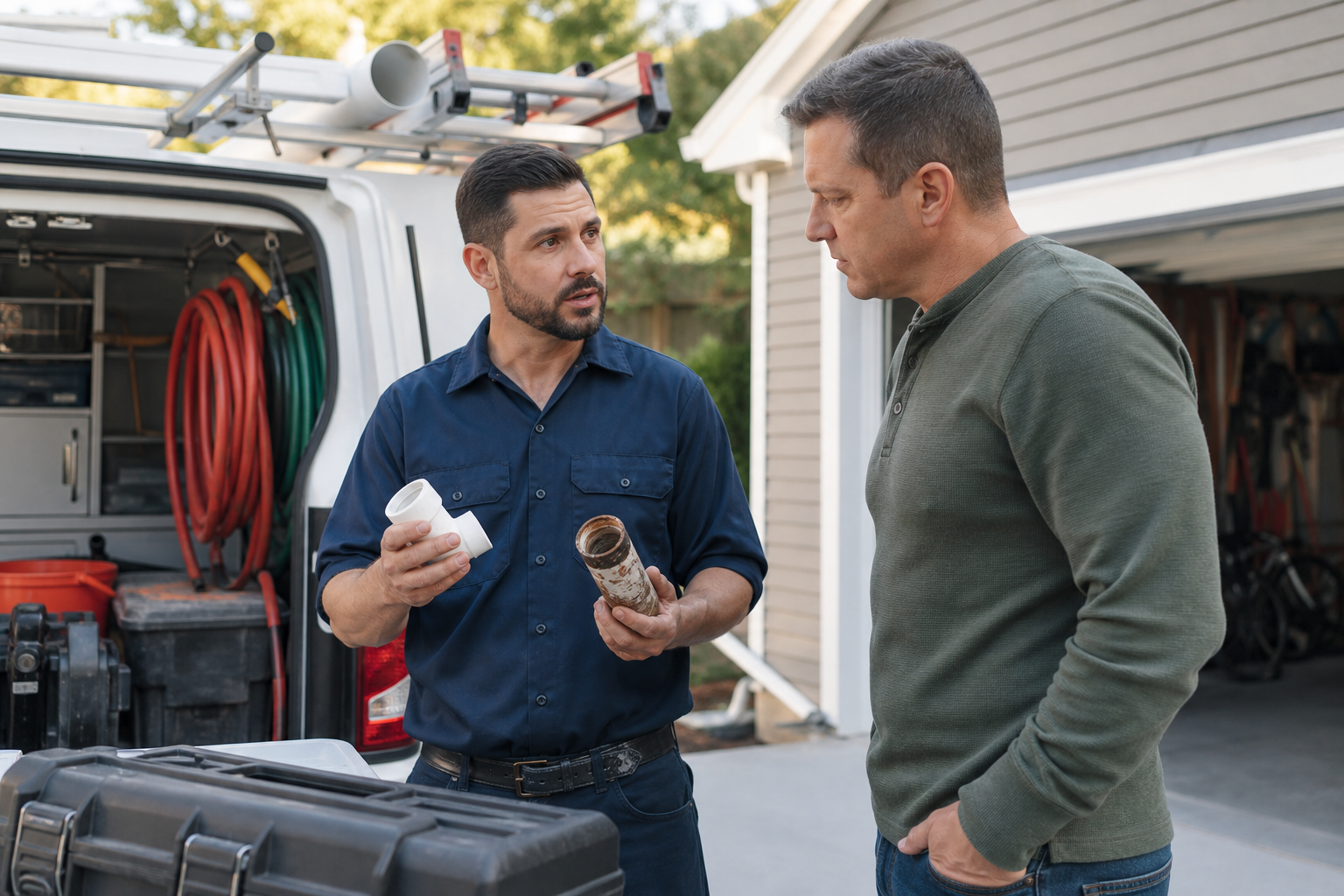
While the technician is onsite, the customer has context. They can see the corroded fitting, hear the explanation of what failed, and ask the practical questions: How bad is it? How long can it wait? What are the options? What does the work include?
The moment the truck pulls away, the buying window starts closing.
Now the customer is back at work, a spouse wants to weigh in, or the quote is competing with school emails, receipts, and dinner plans. The plumbing problem has not disappeared, but its place at the top of the customer’s mind has changed. What felt urgent at 10:30 a.m. becomes something to revisit after dinner—or after they get another estimate.
A polished proposal protects the selling moment by making the next step obvious. An e-signature removes the friction of printing, scanning, or trying to approve a job over a vague text thread. A deposit option converts agreement into commitment before hesitation has room to grow.
A Quote Is Not a Number. It Is the Next Step
Too many plumbing estimates fail because they answer the wrong question.
A customer is not only asking, “What is the price?”
They are asking, “What happens next?”
“Replace water heater — $X” may be enough for a technician’s notes. It is not enough for a homeowner trying to make a decision under pressure. Does that price include removal and disposal? Is the replacement a standard unit or an upgrade? Are permits, valves, fittings, or code-related work part of the scope? Can the work be scheduled immediately? Is a deposit required?
A customer-facing PDF puts those answers in one place. It gives the homeowner a readable scope, a clear price, and a straightforward way to move forward. It separates options so the conversation does not collapse into a blur of numbers. It creates a record of what was offered and selected while the technician’s explanation is still fresh.
When Stripe payment collection is attached to the customer-facing quote PDF, the customer can pay an appropriate deposit from the same document. Instead of waiting for a separate invoice or an office callback, they can approve the work and take the payment step while they are ready to act.
That is not pressure. It is clarity.
The best plumbing sales process does not force customers to remember a conversation. It documents that conversation in a form they can understand, share, approve, and pay from.
Water Heaters Need More Than a One-Number Answer
A failed water heater can look simple from the outside: replace the tank, collect payment, move on. In practice, the homeowner may be deciding between capacities, efficiency levels, fuel types, space constraints, and whether to make a like-for-like replacement or invest in a longer-term upgrade.
Those decisions are hard to make from memory.
Imagine a technician standing in a garage with a homeowner whose current unit has failed. The customer hears that one replacement is available quickly, another may offer better efficiency, and a third option better fits a growing household. If all three choices are discussed verbally, the homeowner may remember only the highest number. If the options arrive later in an unstructured email, they may be difficult to compare with a spouse or family member.
A good-better-best proposal gives the decision structure. It can show the standard replacement, the better-fit upgrade, and the premium option in plain language, with clear scope and pricing. The customer stops asking only, “Which one is cheapest?” and can start asking, “Which one actually makes sense for this house?”
Once the customer chooses, the e-signature and deposit create a clean transition from estimate to booked work. The office does not have to interpret a text that says, “They think they want the middle one.”
Sewer-Line Work Needs a Paper Trail, Not a Memory
Sewer-line jobs are where informal quoting gets expensive fast.
These projects often involve a camera inspection, diagnostic findings that must be explained carefully, competing repair approaches, material planning, excavation considerations, and labor that needs to be reserved. The customer may be deciding between a targeted repair and a more extensive solution based on the condition of the line.
That decision should not live only in a technician’s notes and a string of messages.
Consider a homeowner who has seen roots, offsets, or recurring blockage on a sewer camera inspection. They may understand the urgency in the moment, but they still need something concrete to review. A clear proposal can identify the recommended work, distinguish it from alternatives where appropriate, explain the scope in plain language, and make the required deposit visible before the company commits equipment, materials, and crew time.
That is not paperwork for its own sake. It is what keeps a difficult field job from becoming an even messier office process.
When the customer can review the proposal, sign electronically, and pay from the same flow, the company no longer has to chase the sale through a chain of phone calls. The job moves forward because the approval is real, not assumed.
Repipes Need a Document the Whole Household Can Understand
Large repipe jobs often involve more than one decision-maker. The homeowner who met the technician may need to review the work with a spouse, property manager, family member, or business partner before making a commitment.
That is where a clean PDF matters.
A handwritten quote or half-finished text thread is easy to misunderstand. It may not clearly separate the base scope from selected upgrades, identify exclusions, or explain which fixtures, lines, access points, and restoration items are included. That ambiguity creates trouble later, especially when a project is larger than a same-day repair.
A proper proposal gives the customer something useful to share. It lays out the approved scope in a form that is easier to review than a verbal recap. It also reduces the chance that someone later says, “I thought that was included,” when it was never part of the agreement.
That kind of clarity is customer service. It is also operational discipline.
A signed proposal creates a record of the agreed scope. A deposit indicates that the customer is ready to proceed. Together, they move a project from uncertain interest to work the company can responsibly schedule.
Dispatch Gets the Truck There. The Quote Layer Gets the Job Moving
Many plumbing companies already have dispatch under control. They know how to answer the phone, route the truck, assign the technician, and keep the day moving.
That matters. But dispatch solves only one part of the job.
Dispatch answers operational questions: Who is available? Where is the next stop? What is the arrival window? Which customer needs attention now?
The proposal layer answers a different set of questions: What exactly did the customer approve? Which option did they choose? Has the agreement been signed? Has a deposit been paid? What document can the office and customer both rely on?
Those are not the same job.
A company can have excellent routing and still lose revenue if every quote has to be rebuilt after the service call. When the technician has to text notes to the office, wait for someone to assemble an estimate, and hope the customer answers later, the business has turned an urgent buying moment into an administrative delay.
The cleaner approach is to turn the field diagnosis into a customer-facing document immediately. That is where quote software earns its place: not by replacing the technician’s judgment, but by helping that judgment become a clear approval path.
For more ideas on improving the process between the first call and final payment, plumbing owners can explore the [Flash Quote blog](https://flashquoteapps.com/blog) and the broader [Flash Quote](https://flashquoteapps.com) platform.
The Office Should Not Have to Rebuild the Sale
When the field process is weak, the office pays for it.
Someone has to re-enter notes, decipher a photo, locate pricing, follow up on an approval that may or may not have happened, and request a signature that should have been captured when the customer was engaged. None of those tasks is impossible. All of them consume time that could be spent scheduling work, serving customers, or collecting completed invoices.
A customer-facing quote PDF creates a shared source of truth. The office can see what was presented, what the customer selected, whether the document was signed, and whether payment has been made. The technician does not need to become an office administrator after every diagnosis, and the customer does not need to repeat the decision they already made in person.
A deposit tied to the proposal also reduces the gap between “yes” and actual commitment. That matters because an estimate that is verbally accepted but never signed or funded is not the same as a booked job.
The Deposit Is the Moment Intent Becomes Real
It is easy to treat deposits as a back-office detail. For larger plumbing work, that misses the point.
The deposit is often the moment customer intent becomes reliable.
It tells the company that the customer is not merely interested—they are proceeding. It gives the office confidence to reserve labor, order materials, schedule a return visit, or allocate equipment. It gives the customer a clear signal that the work has moved from discussion to action.
Not every plumbing job requires a deposit, and every company should apply its own pricing and payment policies. But when a deposit is appropriate, the collection experience matters.
If the customer can approve the proposal and pay from the same PDF, the momentum stays intact. There is no separate invoice to chase. No delay while an office team member sends another email. No uncertainty about whether the customer intends to move forward.
That is why faster dispatch alone does not improve cash flow. A truck at the curb does not produce a booked job if the estimate drifts into limbo after the diagnosis.
Clarity Collects Faster Than Pressure
The strongest plumbing sales process does not feel aggressive. It feels organized.
The technician explains the issue. The customer sees a clear proposal. The scope is documented in plain language. The approval is signed. The deposit is collected. The office receives a record it can trust, and the work moves forward without guesswork.
That is what a strong quote-to-cash workflow does. It protects the selling moment before urgency fades, keeps the office from reconstructing the sale later, and turns a diagnosed plumbing problem into a scheduled job while the customer is still ready to act.
In plumbing, the truck gets you to the house. The proposal gets you paid.