The Missed-Call Recovery Quote: How Contractors Turn After-Hours Leads Into Booked Jobs by Morning
The MissedCall Recovery Quote: How Contractors Turn AfterHours Leads Into Booked Jobs by Morning
A plumbing company misses three calls between 6:10 p.m. and 8:40 p.m. One is a tire-kicker. Two are not. By 7:15 the next morning, one of those homeowners has already booked with someone else, and the other is waiting on whoever sends the first clear price and scope. That is how work gets lost now—not always because your price was wrong, but because your follow-up was late.
That is the whole point of a missed-call recovery system. Contractors who pair after-hours lead capture with fast, professional quote follow-up save jobs that would otherwise go to the next name in the search results. Not every missed call deserves a quote by sunrise. But the high-intent ones often do, and the companies that build for that reality create a real edge without adding more office chaos.
Most owners already know speed matters. The incomplete version is thinking speed means “call back faster.” It matters, but callback speed alone does not solve the problem. The lead still needs to be organized, qualified, priced, and moved into a clean quote and a sales-ready follow-up. Otherwise the office gets busy, the handoff gets messy, and the lead goes cold in the gap between “we called them back” and “we gave them something they can say yes to.”
That gap is where a lot of good jobs disappear.
**After-hours leads are usually better than people admit**
The common assumption is that after-hours leads are messy, low-quality, or shopping around. Some are. But a lot of them are the opposite.
A homeowner calling a roofer at 8:30 p.m. after a storm is not casually browsing. A family calling an HVAC company at 9:00 p.m. when the system quits in July is not building a spreadsheet. A customer calling a plumber after finding water under a sink at dinner is trying to solve a problem now, even if the actual work happens tomorrow morning.
These leads have urgency built in. That does not mean every one is an emergency service call. It means the buyer is in motion. They are actively looking, actively comparing, and usually contacting more than one contractor. If your business misses the call and does nothing useful until late the next day, you are not really in the running anymore.
This is especially true for local service businesses where trust gets formed fast. Homeowners do not have much to evaluate in the first 12 hours. They have your call response, your professionalism, your clarity, and how quickly you turn a vague problem into a next step. That is often enough to separate one company from another before anyone steps on the property.
The companies that win these jobs are not always the cheapest. They are often the first organized company.
**What actually breaks after a missed call**
Most contractors do not lose these leads because they are lazy. They lose them because the handoff chain is weak.
It usually looks like this:
- The call comes in after hours or while the office is slammed.
- It goes to voicemail, an answering service, or gets buried in a call log.
- The customer leaves partial details, or no message at all.
- Someone in the office sees it later but does not know if it is service, estimate, emergency, or spam.
- A callback gets delayed because dispatch is busy.
- A field rep gets asked for pricing context with half the information.
- The quote waits.
- The lead cools off.
Every contractor has some version of this. Roofing companies feel it after weather events. HVAC shops feel it during peak heat and cold snaps. Plumbers feel it on high-volume service days when the phones light up before the schedule catches up. Electrical contractors feel it when office staff is juggling permits, scheduling, and active jobs while inbound estimates pile up.
The damage is not just the missed call itself. It is the wasted morning after. Crews are waiting on paperwork. Salespeople are asking for missing job notes. Office managers are trying to reconstruct context from voicemail scraps. Nobody is moving cleanly because the lead did not come in cleanly.
A missed-call recovery process is really a context recovery process. That is the part most shops overlook.
**Why “just call them back” is not enough**
A callback without a next step often creates one more loose end.
If your office calls at 7:45 a.m. and says, “Sorry we missed you, what did you need?” that is better than silence. But it still puts all the work back on the customer. They have to retell the story, hope someone writes it down correctly, and wait again while your team figures out the quote. Meanwhile another contractor may have already texted, confirmed the issue, and sent over a clean estimate window or budgetary quote.
Speed only counts if it carries the customer forward.
That is why the stronger workflow is not just: 1. Missed call 2. Callback
It is: 1. Missed call 2. Lead details captured 3. Issue categorized 4. Priority assigned 5. Callback with context 6. Quote or estimate follow-up sent fast 7. Clear booking path offered
That sequence protects trust. It also protects margin because rushed, disorganized quotes tend to be the ones where scope gets missed, pricing gets softened, or crews show up to a job that was never properly qualified.
Fast does not mean sloppy. Fast means prepared.
**The simple missed-call recovery workflow that works**
You do not need a giant system to improve this. You need a consistent one.
Here is the practical version.
**1. Capture every missed call into one visible queue**
If after-hours calls go to voicemail, answering service, web form, or text, they all need to land in one place the office can review first thing. Not three inboxes. Not someone’s personal phone. One queue.
The rule should be simple: if a customer reached out and did not connect, the lead is visible by morning with a name, number, timestamp, and whatever issue detail was captured.
This sounds obvious. It is not. A lot of shops still lose leads because call data lives in too many places.
**2. Sort by urgency, not arrival order alone**
A missed call about a new water heater estimate is different from “AC out, baby in the house,” and both are different from “need roof quote next month.” You do not need a complicated scoring model. You need labels.
At minimum, sort missed calls into: - emergency or urgent service - same-day service opportunity - estimate request - low-information callback needed
That lets the office attack the morning in the right order instead of the easiest order.
**3. Call back with a script that moves toward a quote**
Not a stiff script. A working one.
The callback should confirm: - what happened - where the job is - what trade and service type it falls under - whether photos or measurements are available - whether the customer wants repair, replacement, inspection, or pricing
Then the rep should set the next step immediately: - schedule a visit - send a budgetary quote - send a formal estimate - ask for photos and promise a quote window
The point is to leave that call with enough information to move the lead forward, not just mark “customer contacted.”
**4. Turn the job details into a clean quote fast**
This is where many shops still bog down. The office got the lead back, but now estimating becomes the bottleneck.
A good missed-call recovery process depends on a fast quote process. If the callback happens at 8:00 a.m. and the quote does not go out until 4:30 p.m., your “speed” was mostly theater.
For a roofer, that may mean using photos, roof type, square count, leak description, and service minimums to send a fast repair estimate or inspection proposal. For a plumber, it may mean turning a fixture replacement request into a clear line-item quote while the lead is still warm. For an HVAC company, it may mean getting a replacement consultation or repair visit quote out before lunch. For an electrician, it may mean taking a panel, lighting, or troubleshooting request and packaging it into a professional estimate without waiting for a pile of manual formatting.
This is exactly where contractor quote software earns its keep. Not because software is exciting. Because the office does not have time to rebuild every quote from scratch while the phones keep ringing.
**5. Send sales-ready follow-up, not just a PDF attachment**
A quote without context is weaker than most contractors think.
The best follow-up includes: - a clear summary of the problem or requested work - what is included - what happens next - how to approve or schedule - a contact path for questions
That last piece matters. Homeowners often hesitate not because they object to price, but because the next step feels unclear. A quote that arrives quickly and reads professionally lowers friction. It shows the company has its act together.
That matters more after a missed call, because you are rebuilding trust you did not get to establish on the first ring.
**What this looks like in real trades**
The workflow gets easier to understand when you see it in the field.
**Roofing**
A homeowner calls at 7:40 p.m. after spotting a ceiling stain following heavy rain. No answer. They leave a voicemail and upload two photos through your site.
By 7:15 a.m., your office sees: - missed call - leak concern - neighborhood - photos attached - request time
Instead of a generic callback, your team calls with context, confirms the leak area, asks a couple of roof-age questions, and sends a same-morning inspection quote or repair visit estimate. If you handle roofing work regularly, a dedicated roofing estimate app helps turn those details into a professional quote quickly enough to stay in front of the buyer.
That is not magic. It is organized recovery.
**Plumbing**
A customer calls at 8:12 p.m. about a leaking water heater. They do not get through. They text a photo after the missed call.
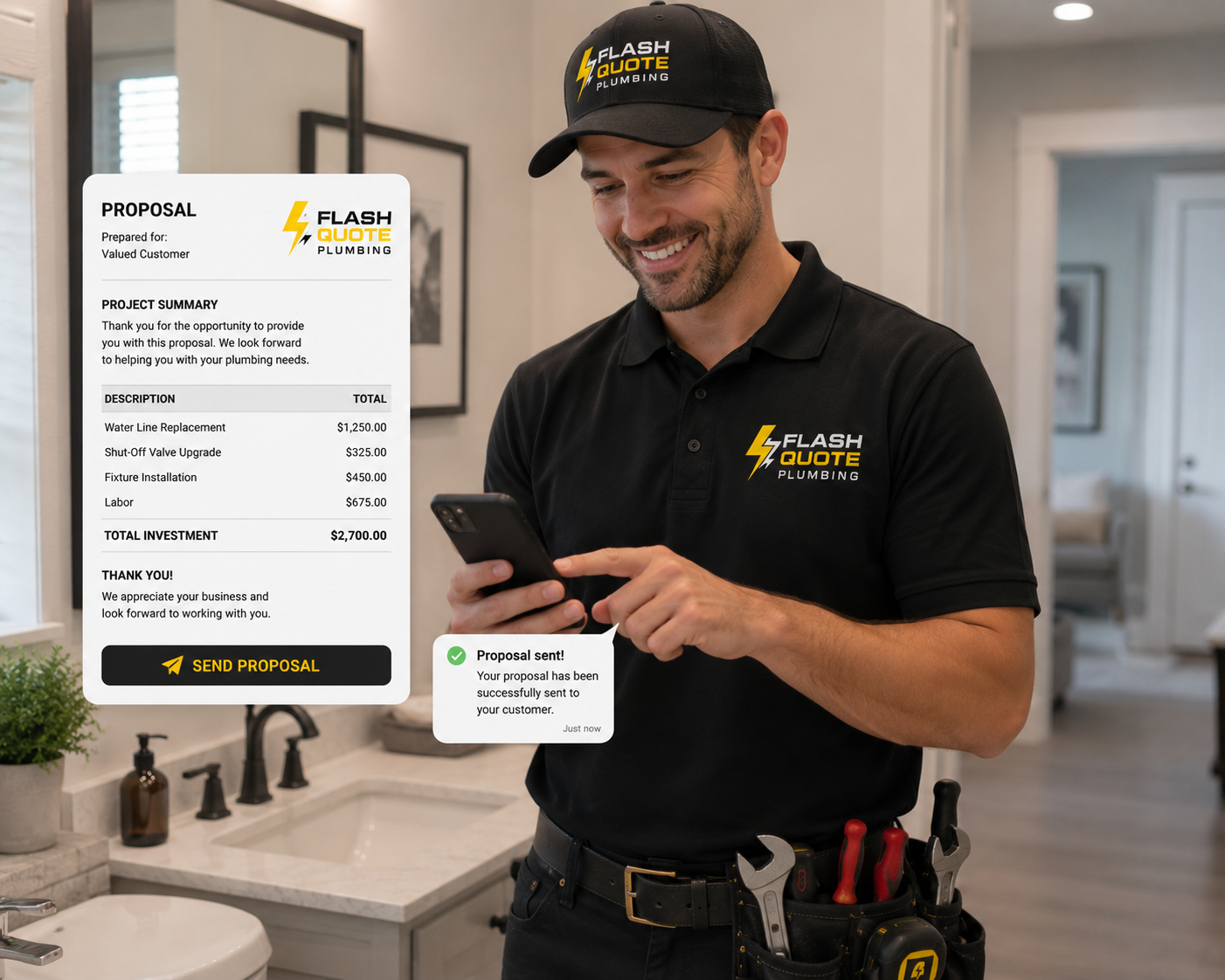
By morning, your office knows this is not a vague “call me back.” It is a water heater lead with visible urgency. The rep confirms age, tank size, active leaking, and access, then uses a plumbing quote app or internal pricing template to send a fast replacement or service quote.
That simple move changes the conversation. You are no longer the contractor who “still needs to look into it.” You are the contractor who responded with a real next step.
**HVAC**
An AC failure call comes in at 9:05 p.m. during a heat wave. The customer leaves a message saying the unit is blowing warm air.
At 7:30 a.m., your team calls back, confirms equipment type, age, thermostat behavior, and whether the system is fully down. Then you send a service call quote or next-available diagnostic visit. Shops using an HVAC quote tool can move faster here because they are not building the estimate language from zero every time.
During peak season, the winner is often the shop that keeps the office from getting buried.
**Electrical**
A homeowner misses your office after dinner and wants pricing on a panel upgrade before closing on a house. That lead is not urgent in the emergency sense, but it is highly actionable.
If your office can recover the call, collect service size, home age, timeline, and inspection context, then send a clean quote request follow-up or consultation estimate early, you look far more credible than the contractor who calls two days later asking them to repeat everything.
In every trade, the pattern is the same: response matters, but organized response closes the gap.
**The hidden benefit: your office gets calmer**
This is the part owners feel after a few weeks.
A real missed-call recovery process does not just save leads. It reduces morning thrash.
When after-hours inquiries come in organized, your office is not digging through voicemails while dispatch asks for schedule changes and techs ask where their paperwork is. When quote creation is faster, salespeople are not waiting on scattered notes. When follow-up is standardized, fewer leads get stuck in “someone needs to get back to them.”
That lowers friction across the whole operation.
It also creates cleaner accountability. You can actually see: - how many after-hours leads came in - how many were contacted by a target time - how many received a quote - how many turned into scheduled work
Without that visibility, missed-call recovery feels random. With it, it becomes trainable.
**How to implement this without making the office hate it**
The mistake is overbuilding.
You do not need six new automations, three approval steps, and a giant playbook no one will read. Start tighter.
**Pick a first-response window** Set a simple standard for next-morning follow-up. For example: all qualified after-hours leads get reviewed by 7:30 a.m. and first contact begins by 8:00 a.m.
**Use a small set of lead categories** Do not create twenty statuses. Use the minimum that helps people act.
**Standardize quote inputs** For each trade, decide the few details needed to build a fast quote or estimate path: - roofing: leak type, roof age, photos, material type - plumbing: fixture or appliance type, issue symptoms, access, photos - HVAC: system type, age, no-cool/no-heat symptoms, occupancy urgency - electrical: service type, panel size, project scope, timeline
**Build repeatable quote templates** This is where Flash Quote can help. If your team regularly turns raw job details into fast, professional quotes and sales-ready follow-up, the process gets easier to scale without losing quality. The goal is not to automate judgment out of the job. It is to remove the delay between “we know what they need” and “the customer has something clear in hand.”
**Track outcomes weekly** Not with a giant report. Just enough to learn: - How many after-hours leads came in? - How many got contacted by the target time? - How many got quotes the same morning? - Where did handoffs break?
That is how you improve the system instead of just hoping people hustle harder.
**Where Flash Quote fits**
Most contractor offices do not need more theory around lead speed. They need a cleaner path from inbound job details to a quote that looks professional and gets sent while the lead is still alive.
That is the practical value of Flash Quote. It helps trade contractors turn job details into fast, professional quotes and sales-ready follow-up, which is exactly what a missed-call recovery system depends on. If your team is strong on service but slow on estimate turnaround, the problem is usually not effort. It is workflow.
You can see more contractor workflow ideas on the Flash Quote blog, and if your process is trade-specific, the roofing, plumbing, and HVAC pages show how that quoting speed plays out in the field.
**The contractors who recover fastest are not just faster on the phone**
The obvious story is that local service buyers reward whoever answers first. True enough. But the better story is that buyers reward the first company that makes the job feel real, understood, and easy to move forward.
That is why missed-call recovery matters so much. It is not a call-center tactic. It is an operations discipline. The shops that get good at it do something simple and rare: they treat the hours between a missed call and the next morning like a sales window worth protecting.
And in a market where homeowners call three companies before breakfast, that window is often the job.