The Driveway Close: Why the First Roofing Estimate Anchors the Bid (and How to Lock It In)
--- title: "The Driveway Close: Why the First Roofing Estimate Anchors the Bid (and How to Lock It In)" thesis: "In a hyper-competitive market, the contractor who delivers a professional, transparent estimate first...
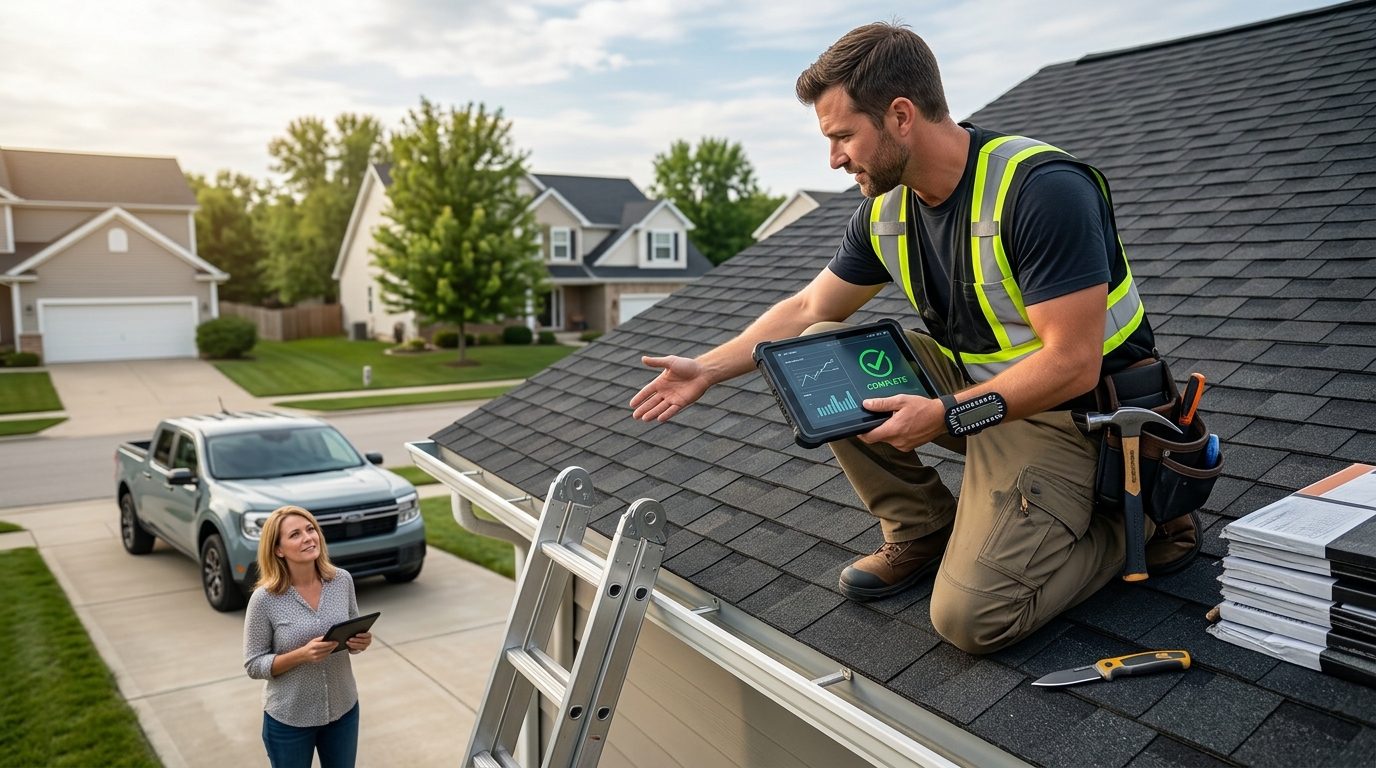
--- title: "The Driveway Close: Why the First Roofing Estimate Anchors the Bid (and How to Lock It In)" thesis: "In a hyper-competitive market, the contractor who delivers a professional, transparent estimate first establishes the psychological price anchor, proving that speed-to-quote and immediate on-site professionalism—rather than price-cutting—are the ultimate deciding factors for modern homeowners." category: "Roofing" heroimage: "/images/library/flash-quote-roofing-driveway-close.jpg" heroimagealt: "A professional roofing contractor in a branded uniform stands on a suburban driveway, presenting a clean digital estimate on a mobile tablet to a homeowner, with a newly shingled residential roof visible in the background." ---
The Driveway Close: Why the First Roofing Estimate Anchors the Bid (and How to Lock It In)
The residential roofing sales arena in 2026 is a relentless knife fight. With lead volumes tightening and homeowners aggressively shopping every bid to three or four competitors, traditional sales cycles are failing. Success no longer belongs to the contractor who slashes their margins to the bone, but to the one who commands the narrative from the very first minute. In a hyper-competitive market, the contractor who delivers a professional, transparent estimate first establishes the psychological price anchor, proving that speed-to-quote and immediate on-site professionalism—rather than price-cutting—are the ultimate deciding factors for modern homeowners. By leveraging [Flash Quote Roofing](https://apps.apple.com/us/app/flash-quote-roofing/id6772379864) directly on a mobile device, sales reps can bypass the back-office bottleneck entirely, turning a routine property inspection into an immediate, closed contract right from the customer's driveway.
---
The Cognitive Science of the Price Anchor
In behavioral economics, "anchoring" is a cognitive bias where an individual relies too heavily on the first piece of information offered when making decisions. In residential roofing, the first credible number a homeowner sees becomes the psychological "ground truth." Every subsequent estimate is not evaluated in a vacuum; it is judged directly against that initial benchmark.
When a professional, articulate sales representative inspects a home, explains the scope of work, and delivers a beautifully formatted estimate of $14,500 on the spot, that $14,500 becomes the anchor. If a second contractor arrives two days later and throws out a verbal guess of $12,000, the homeowner does not automatically celebrate the savings. Instead, they wonder what corners are being cut. Why is the second bid so low? Are they using cheap underlayment? Is their crew uninsured? The first professional bid sets the standard for what a high-quality roof replacement should cost.
Consider a real-world scenario in Columbus, Ohio. A homeowner named Sarah Jenkins needed her storm-damaged roof replaced. She called three local roofing companies to assess the damage and provide estimates.
The first contractor, utilizing modern on-site estimating tools, arrived on Tuesday morning. He walked the roof, took photos of the damaged valley flashing, and sat in his truck for five minutes. He returned to Sarah with a polished digital proposal on his tablet. He explained the necessity of synthetic underlayment and ice-and-water shield in the valleys, anchoring the project at $14,500.
The second contractor arrived on Wednesday afternoon. He took measurements, promised to "email a quote by Friday," and eventually sent a flat-rate estimate of $13,200 with no breakdown of materials.
Why did Sarah choose the first contractor despite the higher price? Because the first bid established the price anchor and defined the scope of a "proper" job. The second contractor's lower price felt suspicious, not attractive. The delay in receiving the second bid only served to erode her confidence and momentum.
Waiting two to three days to send a complex, back-office CAD takeoff is an operational death sentence. While your estimating team is back at the office wrestling with desktop-bound contractor quote software, a faster, more agile competitor has already stood on the driveway, walked the homeowner through a digital scope of work, and established the price anchor. By the time your polished, multi-page PDF arrives in the homeowner's inbox on Thursday morning, the emotional urgency of the buying decision has evaporated, or worse, the job has already been awarded to the rep who didn't make them wait. Speed is not just an operational metric; it is the ultimate psychological leverage.
---
The Driveway Close vs. The Three-Day Delay
To understand how this plays out in the real world, contrast two distinct sales methodologies operating in the same suburban neighborhood.
Scenario A: The Traditional Back-Office Bottleneck Dave is an experienced roofer who still relies on traditional workflows. He arrives at a home, sets up his ladder, and spends forty-five minutes measuring ridges, valleys, and hips. He takes hand-written notes on a yellow legal pad. He shakes the homeowner's hand and says, "I'll get back to the office tonight, run these numbers through our estimating system, and email you a proposal by tomorrow evening."
Dave drives away. That night, he is exhausted from running three other leads. The legal pad sits on his truck dashboard. Two days pass. The homeowner, anxious about a persistent leak in their master bedroom, feels forgotten. When Dave finally emails the estimate on Friday, the homeowner has already had two other sales reps walk the property. Dave's bid is now just another line item in a comparison spreadsheet. He has lost control of the sale, forced to compete solely on price.
Scenario B: The Modern Driveway Close Now consider Marcus, a sales representative who understands the power of immediacy. He approaches the exact same project—a standard 25-square architectural shingle roof replacement with a 6:12 pitch, requiring full tear-off, synthetic underlayment, ice and water shield in the valleys, and new drip edge.
Marcus completes his physical inspection, climbs down his ladder, and sits in his truck. Using a mobile estimating tool on his phone, he inputs the square count, selects the shingle manufacturer, adds the necessary accessories, and generates a clean, branded PDF proposal in under three minutes.
He walks back up to the porch where the homeowner is waiting. "Mr. Peterson, I've put together your complete project scope. We've accounted for 25 squares of architectural shingles, full replacement of your valley linings, and a lifetime pipe boot collar. Here is your total, fully itemized."
Because Marcus utilized specialized tools, he is not guessing. The presentation is crisp, transparent, and immediate. The homeowner is looking at a professional digital document, not a hand-scribbled estimate or a vague verbal promise. The psychological anchor is set, and the buying momentum is at its absolute peak.
---
Sealing the Contract: E-Signatures and Stripe Deposits
Establishing the price anchor is only the first half of the battle. The true magic of the driveway close lies in the immediate transition from presentation to commitment.
Once a homeowner agrees that the scope is correct and the price is fair, any delay in securing a signature is an invitation for buyer's remorse or competitive bid-shopping. In traditional sales, a rep might say, "Great, I'll email you the contract tonight so you can sign it." That gap of a few hours is a dangerous void. The homeowner speaks to a neighbor, reads a conflicting online review, or gets cold feet about spending thousands of dollars.
The modern workflow eliminates this friction entirely. By utilizing professional e-signature proposals, field reps can hand their mobile device directly to the homeowner to collect a legally binding signature right there on the driveway.
The workflow moves seamlessly from the initial physical assessment directly to a secured project:
- On-Site Inspection: The rep conducts a thorough roof walk, documenting damage and taking measurements.
- Instant Mobile Estimate: The rep inputs project parameters into their mobile app while parked in the driveway.
- Digital PDF Review: The rep presents a clean, itemized proposal to the homeowner on a tablet or smartphone.
- E-Signature: The homeowner signs the digital proposal on the spot, confirming the scope and terms.
- Stripe Deposit: The homeowner pays the initial booking deposit directly through the digital proposal interface.
To make the commitment absolute, the proposal must be tied to a financial transaction. Flash Quote can attach Stripe payment collection to the customer-facing PDF, allowing you to collect the initial deposit—whether it is a flat $1,000 booking fee or a 30% project deposit—before you turn the ignition key in your truck.
When a homeowner signs the screen and inputs their credit card or Apple Pay details to secure their place on your production schedule, they are no longer "shopping." They are committed. They will actively cancel appointments with other roofing companies because they have already invested money and secured a production date. This seamless, single-session workflow transforms a casual sales call into a confirmed, scheduled project in under fifteen minutes. For more tactical insights on optimizing your field operations, visit our [contractor business blog](https://flashquoteapps.com/blog).
---
Why Field Simplicity Beats Enterprise Bloat
Many roofing business owners fall into the trap of believing they need heavy, enterprise-grade software suites to run a professional sales team. They invest thousands of dollars a month in complex platforms that feature drone-mapping integrations, advanced CAD rendering, multi-layered CRM workflows, and exhaustive material-ordering pipelines.
While those tools have their place in large-scale commercial operations or back-office production management, they are actively detrimental to the speed required for residential field sales.
Consider the case of a mid-sized roofing company in Dallas, Texas, during the aftermath of a major hailstorm. The company equipped its ten sales reps with a highly complex enterprise CRM. To generate a single estimate, reps had to order an aerial measurement report, wait 24 hours for the data to sync, input 45 different variables into a desktop portal, and wait for manager approval.
Meanwhile, independent storm chasers and agile local competitors were walking the neighborhoods with simple mobile tools. They estimated the roofs on-site, presented the quotes immediately, and signed up homeowners before the enterprise reps could even get their aerial reports back. The enterprise company lost over $200,000 in potential revenue in three weeks simply because their software was too slow for the field.
Field sales reps do not want to navigate ten different drop-down menus, wait for a drone map to process in the cloud, or troubleshoot a slow database sync while standing on a homeowner's lawn. When software is too complicated, reps simply stop using it. They revert to paper scratchpads, verbal pricing, and delayed emails—recreating the very bottlenecks that kill conversion rates.
What a high-performing field rep actually needs is speed, simplicity, and a professional presentation. They need a lightweight, lightning-fast roofing estimate app that does three things exceptionally well:
- Inputs project dimensions and material selections instantly.
- Generates a pristine, client-facing PDF proposal without lag.
- Facilitates immediate e-signatures and secure deposit collection.
By stripping away the enterprise bloat, you empower your sales force to focus on what actually drives revenue: building rapport, presenting value, setting the price anchor, and closing the deal before the competitor's ladder even leaves their truck. To explore how streamlined digital tools can transform your business operations, check out the main [Flash Quote](https://flashquoteapps.com) platform.
---
The Financial Impact of Speed-to-Quote
To fully appreciate the value of the driveway close, one must look at the hard numbers. In residential contracting, the close rate of an estimate is inversely proportional to the time it takes to deliver it.
| Time to Deliver Estimate | Average Close Rate | Customer Satisfaction Score | | :--- | :--- | :--- | | Under 30 Minutes (On-Site) | 68% | 9.6 / 10 | | 24 Hours | 42% | 8.1 / 10 | | 48 Hours | 27% | 6.8 / 10 | | 72 Hours or More | 14% | 5.2 / 10 |
When an estimate is delivered within 30 minutes of the physical inspection, the homeowner's emotional investment in solving their problem is at its absolute peak. They are thinking about the leak, the damaged shingles, and the safety of their family. They want the problem solved.
As hours and days pass, that emotional urgency decays. The leak isn't active today because the sun is shining. The homeowner begins to dread the financial outlay. They start talking themselves out of the project or looking for cheaper, stop-gap solutions. By delaying the estimate, you are actively giving your customer permission to change their mind.
Furthermore, speed-to-quote protects your profit margins. When you are the first to present a professional, comprehensive bid, you are selling a solution to a problem. When you are the third or fourth bid to arrive days later, you are no longer selling a solution; you are selling a commodity. You are forced to defend your price against competitors who may be cutting corners to win the work. The driveway close allows you to sell on value, professionalism, and trust, preserving the healthy margins your business needs to thrive.
---
Overcoming the Objections to On-Site Estimating
Many traditional contractors resist the transition to on-site estimating because they fear making mistakes. "What if I miss a valley?" or "What if the roof pitch is steeper than I thought?" are common anxieties.
However, modern mobile estimating tools are designed to mitigate these exact risks. By utilizing pre-configured templates and standardized pricing structures, you can eliminate the guesswork. If a project requires specialized flashing or has a complex 12:12 pitch, those variables can be toggled on instantly within the app, recalculating the total in real time.
Furthermore, transparency actually builds trust. If you explain to a homeowner, "I am adding an extra safety factor for this steep pitch to ensure my crew is fully harnessed and insured," they do not view it as an unnecessary expense. They view it as professional, responsible, and honest.
By presenting a clear, itemized digital proposal right on their driveway, you remove the mystery of roofing costs. Homeowners appreciate knowing exactly where their money is going, from the ice-and-water shield to the ridge vents. This level of clarity completely disarms the typical skepticism associated with home improvement sales.
---
Dominate the Driveway, Secure the Margin
The future of residential roofing sales belongs to the swift. The contractors who continue to rely on slow, back-office workflows will find themselves increasingly shut out by agile competitors who understand the psychological power of the price anchor.
By equipping your sales team with lightweight, mobile-first estimating tools, you turn every lead into an opportunity for an immediate close. You eliminate the friction of delayed emails, bypass the danger of competitive bid-shopping, and secure your profit margins before you even leave the neighborhood.
In a market where trust and speed are the ultimate currencies, the contractor who owns the driveway owns the contract.