The Driveway Close: How HVAC Contractors Win 2026 Bids Before the Customer Shops Around
The Driveway Close: How HVAC Contractors Win 2026 Bids Before the Customer Shops Around To survive the hyper-competitive 2026 residential market, HVAC contractors must abandon delayed emailing of estimates and adopt an...
The Driveway Close: How HVAC Contractors Win 2026 Bids Before the Customer Shops Around
To survive the hyper-competitive 2026 residential market, HVAC contractors must abandon delayed emailing of estimates and adopt an on-site, instant-quoting workflow that builds immediate trust, secures e-signatures, and captures deposits before leaving the driveway. In an economic climate where cost-sensitive homeowners routinely solicit three to four competing bids for every system replacement, leaving a property with a promise to "send an estimate over tonight" is functionally handing the job to a competitor. The modern residential sales cycle is no longer won in the late-night quiet of an office inbox. It is won at the kitchen table, while the urgency of a breakdown is fresh, the technical diagnosis is clear, and the contractor is standing right in front of the decision-maker.
The shift in consumer behavior throughout 2026 has made speed and transparency the ultimate differentiators. Homeowners no longer tolerate opaque line items or multi-day delays for basic system proposals. When a furnace fails in January or an aging condenser dies during a July heatwave, the customer’s buying intent peaks during the physical service visit. The moment a service technician or comfort consultant steps through the front door, the clock starts ticking. Waiting six hours to build a proposal on a desktop computer back at the shop allows doubt to creep in, invites bargain-hunting web searches, and opens the door for aggressive competitors to step into the void. Winning in 2026 requires closing the loop while your truck is still parked out front.
The Cost of the Midnight Proposal
For decades, the standard operating procedure for residential HVAC companies followed a predictable script. A technician or sales representative visited the home, took physical measurements, checked the breaker panel, inspected ductwork connections, and wrote down equipment model numbers on a paper notepad. They promised to run heat-load calculations back at the office, build a multi-tiered proposal on desktop software, and email a detailed estimate later that evening.
In 2026, that delayed workflow is a primary driver of lost revenue and shrinking margins. When you walk out the door without a signed agreement or an initial deposit, several destructive dynamics take effect immediately:
- Emotional Momentum Evaporates: The acute pain of an uncomfortable home or a failing system degrades into administrative friction once the technician departs. What was an urgent priority during the physical walk-through becomes a passive email sitting in a crowded inbox alongside work messages and promotional junk mail.
- Price Comparison Replaces Value Perception: Stripped of the technician’s live explanation, an emailed PDF becomes a cold number on a screen. Without a representative present to explain why a higher-static variable-speed blower or a matched line set justifies a higher investment, the homeowner inevitably compares the bottom-line cost against cheaper, lower-quality bids.
- Competitor Interception: Modern homeowners do not wait idle. While waiting for your evening email, they are actively scheduling second and third opinions from local competitors who leverage modern contractor quote software to present immediate on-site options.
The contractor who sends their proposal eight hours after leaving the driveway is not entering a negotiation—they are entering an asynchronous price war. To protect your profit margins and eliminate unpaid estimating hours, the proposal process must be compressed directly into the physical appointment.
Anatomy of the Driveway Close: A Four-Step On-Site Framework
Executing "The Driveway Close" does not mean high-pressure sales tactics or rushing mechanical diagnostics. Rather, it means standardizing your physical inspection process so that bid generation takes minutes rather than hours. The entire workflow relies on replacing slow back-office administration with field-ready mobile technology like [Flash Quote HVAC](https://apps.apple.com/us/app/flash-quote-hvac/id6774519518), which empowers field technicians to construct, present, sign, and collect payments on professional proposals before starting their engine to drive away.
A structured, four-step on-site workflow transforms an uncertain sales call into a closed contract:
Step 1: The Tactical Diagnostic and Trust-Building Walkthrough
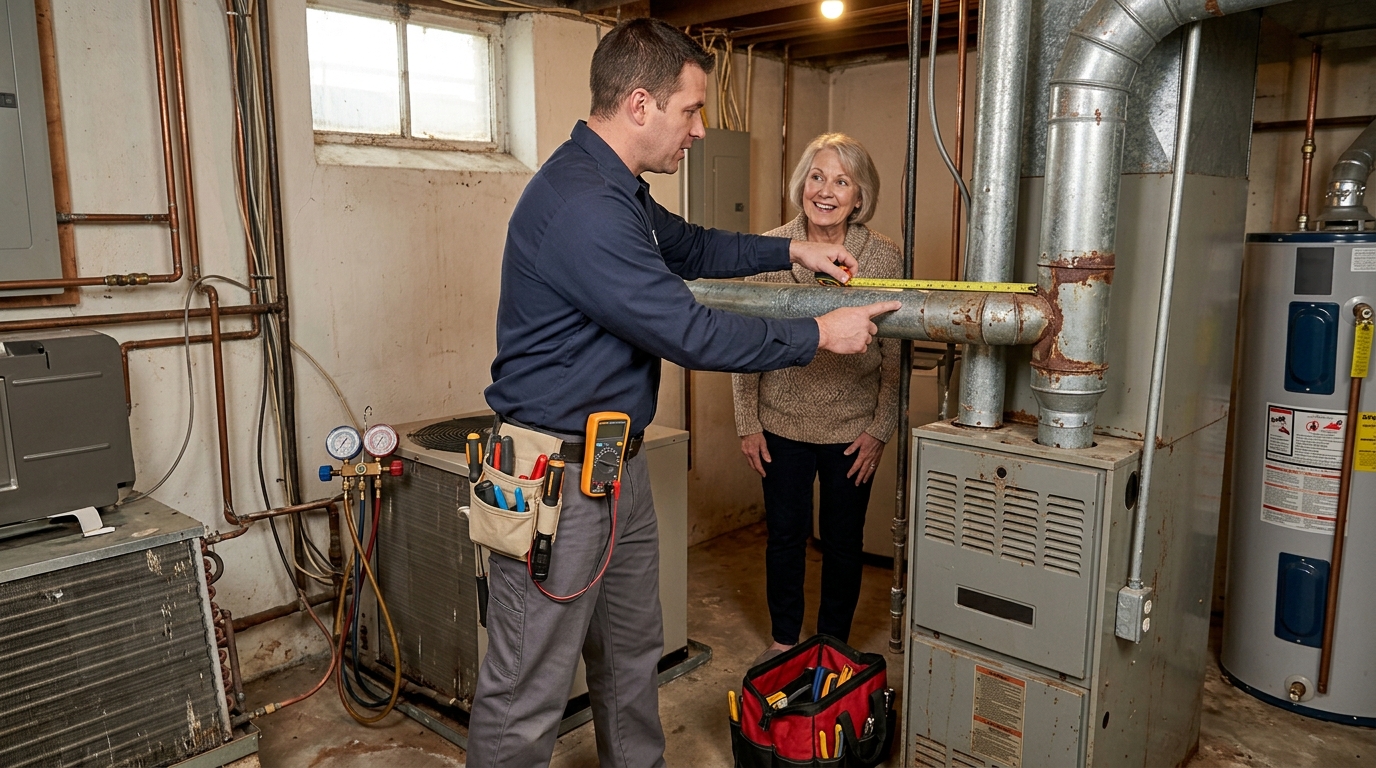
Every legitimate residential quote begins with rigorous, hands-on diagnostics. A technician must physically measure the existing equipment footprint, evaluate line set integrity, check electrical disconnects and breaker sizing, inspect duct transition clearances, and conduct static pressure tests across the air handler or furnace. Relying on remote shortcuts or generic rule-of-thumb square-footage estimates leads to inaccurate equipment sizing and costly callbacks.
The physical inspection builds the foundational trust required to close the sale on the spot. When the homeowner sees a technician taking precise measurements and evaluating airflow dynamics, the technical authority of the recommendation is firmly established. This hands-on transparency makes the homeowner feel safe, respected, and informed.
Step 2: Building Multi-Tiered Options in Real Time
Once physical parameters are established, the technician opens their mobile HVAC quote tool right inside the living room or service vehicle. Instead of typing out custom descriptions from scratch, the app utilizes pre-built, trade-specific line items for equipment, whip and disconnect replacements, pad leveling, line set flushing, drain pan float switches, and permit fees.
In under three minutes, the field tool converts diagnostic inputs into a crisp, professional multi-option proposal—typically presenting Good (14.3 SEER2 Single-Stage), Better (16 SEER2 Two-Stage), and Best (18+ SEER2 Variable Capacity Heat Pump) packages. Presenting options side-by-side shifts the customer's mindset from a binary "yes or no" to a comparative "which option works best for my budget and comfort goals."
Step 3: The Kitchen-Table Presentation and Frictionless E-Signature
With options generated instantly on a mobile tablet or phone, the technician presents the document directly to the customer at the kitchen table. The homeowner reads itemized component breakdowns, warranty coverage details, and clear labor scopes.
Because the customer is looking at an interactive, professionally formatted digital document rather than a handwritten scrawl, confidence is immediate. When the homeowner selects their preferred system tier, the technician leverages integrated e-signature proposals to capture a legally binding digital signature right on the screen. There is no printing, scanning, or delayed follow-up required.
Step 4: Securing the Deal with Instant Stripe Deposit Capture
Securing a signature without securing funds still leaves the job vulnerable to cancellation if the customer receives a lower bid overnight. The final critical element of the driveway close is attaching immediate payment collection directly to the signed document.
By utilizing integrated Stripe payment collection on the customer-facing PDF, the homeowner can instantly authorize a 10% or 20% down payment using a credit card, debit card, or mobile wallet before the technician walks out the door. The moment the deposit clears, equipment is reserved, the install crew is scheduled on the dispatch board, and the customer is completely taken off the market.
Real-World Battlegrounds: Two Field Scenarios from the 2026 Season
To understand how this workflow operates under real-world pressure, consider two common residential sales scenarios encountered by field service organizations every week.
Scenario 1: The High-SEER Heat Pump Upgrade (Summer Heatwave)
Mark Henderson’s 12-year-old R-410A split system has suffered a burnout compressor in mid-July. The attic air handler shows signs of pan corrosion, and the existing return ductwork is undersized for the home's square footage. Mark is anxious about rising energy costs and wants to evaluate modern heat pump technology, but is intimidated by complex rebate structures and high upfront equipment costs.
Under the traditional approach, the salesperson takes pictures, promises to calculate heat loss/gain and utility rebate eligibility back at the shop, and promises a comprehensive proposal via email by 8:00 PM. By 6:00 PM, a competing sales-heavy contractor arrives, presents a basic hand-drawn options sheet, and signs a basic 15-SEER system replacement for $11,500 on the spot. Your comprehensive $14,000 dual-fuel proposal arrives in their inbox at 8:30 PM, unread.
Under the driveway close approach, the technician finishes the attic diagnostic, steps to the service truck, and opens their instant PDF quote app. Drawing from a pre-loaded template, they configure three clear options:
- Good: Standard 14.3 SEER2 Heat Pump system replacement with new whip, pad, and basic digital thermostat.
- Better: 16 SEER2 Two-Stage Heat Pump with a variable-speed air handler, safety float switch, and smart thermostat integration.
- Best: High-Efficiency Inverter-Driven Heat Pump paired with return duct modifications to resolve airflow restriction and maximize local utility electrification rebates.
The technician walks back inside, hands the tablet to Mark, and walks through the clear visual differences between the options. Mark selects the "Better" package for $13,200, feeling informed and in control. The technician taps the signature line for the customer to sign, and the app immediately prompts for the $1,320 job-deposit payment. Mark taps his phone to pay via credit card through integrated Stripe processing. The entire transaction is completed in 18 minutes, equipment is auto-ordered from the supply house, and the install is booked for Friday morning.
| Proposal Field | Details | | :--- | :--- | | Client & Location | Mark Henderson — 482 Elm Street | | Technician / Date | J. Miller (104) — July 16, 2026 | | Selected Option | BETTER - 16 SEER2 Two-Stage Heat Pump System | | Scope of Work | • Remove and dispose of existing R-410A condensing unit & coil• Install 3-Ton 16 SEER2 High-Efficiency Condenser• Install Matched Variable-Speed Air Handler w/ 10kW Auxiliary Heat• Replace electrical disconnect, whip, and composite pad• Flush line set, install bi-flow liquid line filter drier• Code-compliant secondary drain pan with inline float safety switch• Manufacturer 10-Year Parts / 2-Year Labor Warranty included | | Financial Summary | Total Investment: $13,200.00Deposit Required: $1,320.00 (PAID via Stripe)Balance Due: $11,880.00 (Upon Completion) |
Scenario 2: The Emergency Mid-Winter Furnace Failure (Sub-Zero Crisis)
During a sub-freezing January night, a 20-year-old mid-efficiency gas furnace suffers a cracked heat exchanger. The primary limit switch is open, rollout switches show thermal stress, and carbon monoxide readings inside the plenum register at dangerous levels. The system must be locked out immediately for safety.
The technician performs the safety lockout, documents the cracked heat exchanger with clear digital photos attached to the inspection record, and explains the critical safety risk to the homeowner. Panic is high; the home is dropping in temperature rapidly. Instead of leaving the family in the cold while an estimator schedules a visit for tomorrow afternoon, the service technician utilizes their mobile residential HVAC sales workflow to generate an immediate replacement bid right from the living room floor.
Because the system specs and gas line sizes were verified during the emergency call, the technician generates a complete furnace replacement package—including code upgrades for flue venting and gas flex lines—in under two minutes. The PDF invoice and contract are rendered instantly. The homeowner reviews the line items, signs the e-signature proposal, pays the initial deposit via credit card, and secures emergency morning dispatch. The technician leaves temporary space heaters, confident that the $8,500 replacement job is locked in and protected from competing calls.
Dismantling the "Let Me Think About It" Objection
The most common hurdle to closing deals on-site is the classic customer hesitation: "Let me think about it and get back to you." In most cases, this is not a rejection of your price or your company; it is a defense mechanism triggered by a lack of clarity, hidden fees, or fear of making the wrong technical decision.
When you present a delayed, emailed estimate, you have no way to address this hesitation. The customer reviews the price in isolation, feels overwhelmed by the technical jargon, and defaults to inaction or bargain hunting.
By contrast, the on-site workflow allows you to dismantle this objection in real time through three strategic actions:
- Interactive Visual Education: Show, don't just tell. Use the digital proposal to display side-by-side comparisons of energy savings, decibel levels, and warranty terms. When customers see exactly how a higher-tier system pays for itself over time in reduced utility bills, the decision becomes logical rather than emotional.
- Guaranteed Scheduling Windows: Tie the on-site close to immediate operational benefits. Explain that by signing and securing the deposit now, you can lock in the next available installation slot on the dispatch board. In peak seasons, this scheduling guarantee is often more valuable to a homeowner than a minor price discount.
- Transparent, All-Inclusive Pricing: Eliminate the fear of the unknown. Ensure your digital proposal clearly states that the price presented is the final, out-of-the-door cost, with no hidden fees, permit surcharges, or unexpected material costs.
Transitioning your field operations to an instant-quoting model does more than just boost your close rates; it fundamentally respects the customer's time and provides the modern, frictionless buying experience they expect. To learn more about optimizing your business operations and scaling your field team, explore our comprehensive resources on the [contractor estimating blog](https://flashquoteapps.com/blog) or visit the main [Flash Quote](https://flashquoteapps.com) platform to see how simple mobile workflows can revolutionize your daily dispatch.
"In modern residential HVAC, speed and field transparency eat raw sales pitching for breakfast; the contractor who collects the deposit before leaving the driveway is the only one who truly controls their schedule, their margins, and their business."