Stop Leaving Money in the Truck: How Independent Plumbers Secure 30% Margins in a Labor Shortage
Stop Leaving Money in the Truck: How Independent Plumbers Secure 30% Margins in a Labor Shortage The residential plumbing sector is facing an unprecedented operational squeeze. By 2027, the industry is projected to...
Stop Leaving Money in the Truck: How Independent Plumbers Secure 30% Margins in a Labor Shortage
The residential plumbing sector is facing an unprecedented operational squeeze. By 2027, the industry is projected to confront a shortfall of 550,000 skilled plumbers, while material costs have surged over 30% since 2020. In this brutal economic climate, plumbing contractors cannot scale by simply working longer hours; they must bridge the industry's 20-35% margin gap by replacing back-office administrative delays with instant, mobile-first quoting and Stripe-enabled deposits before leaving the customer's driveway. While median service companies scrape by on thin 2% to 8% net margins, top-tier operators systematically secure 20% to 35% margins. The difference isn't the quality of their solder joints—it is the speed of their business operations.
Transitioning to a modern [estimating automation platform](https://flashquoteapps.com) allows independent shops to stop bleeding billable hours to administrative chores. Instead of chasing paper trails after a twelve-hour shift, smart contractors are using a dedicated [Flash Quote Plumbing](https://apps.apple.com/us/app/flash-quote-plumbing/id6775365155) app to build, price, and close jobs right from the cab of their trucks.
The Cost of the Clipboard: Why Back-Office Delays Leak Margins
Paperwork kills momentum. For decades, the standard operating procedure for independent plumbers has relied on a slow, multi-day administrative cycle. A technician diagnoses a residential system, scribbles rough notes on a carbon-copy clipboard, and tells the homeowner they will receive an estimate by email later that evening.
This delay is where profitable jobs go to die. Consider Marcus, a solo operator in Ohio. He finishes a complex water filtration diagnostic at 5:30 PM. Exhausted from a physical day of labor, he promises the homeowner a formal quote "tonight." By the time Marcus drives home, eats dinner, and finally sits down at his laptop at 8:30 PM, several operational leaks have already occurred:
- The Customer Cools Down: The high-intent window of a plumbing emergency or necessary upgrade closes rapidly. Every hour that passes allows the customer to search for alternative quotes, read online reviews of competitors, or reconsider the urgency of the repair.
- Material Price Volatility: Supply house prices fluctuate constantly. A price quoted from memory on a jobsite can easily lead to a loss when the actual invoice from the distributor arrives.
- Unbilled Truck Stock: Small parts—press fittings, brass nipples, shut-off valves, and Teflon tape—frequently slip through the cracks of manual pricing. A handful of forgotten fittings can quietly erase $50 to $100 of gross margin on a single call.
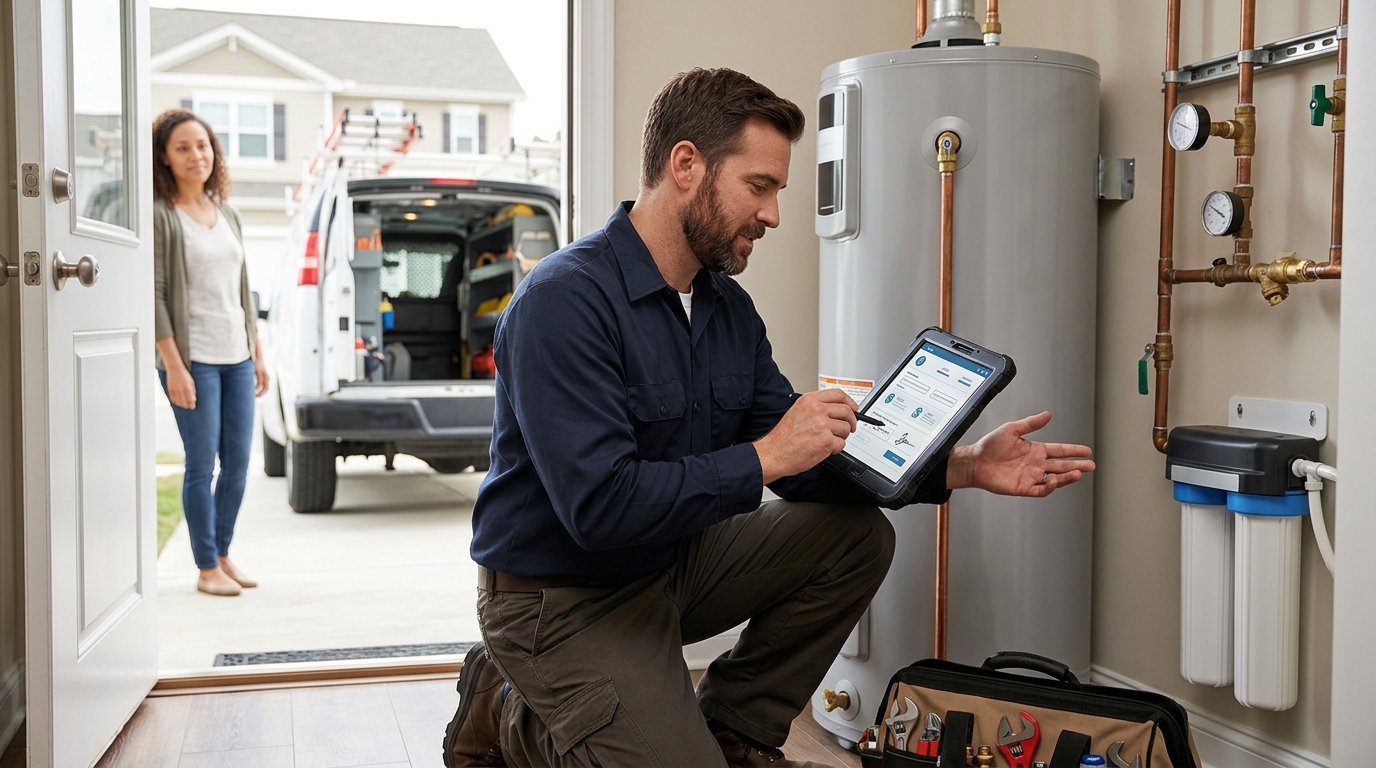
The "driveway close" changes the entire psychology of the transaction. Presenting a professional, itemized digital quote before turning the key in the ignition turns a pending decision into an active job. When homeowners are presented with clear choices on a screen while the technician is still on-site, the friction of decision-making disappears.
Real-World Scenarios: Grounding the Math in the Driveway
To understand how administrative speed translates directly into protected margins, we must look at the actual math of daily field service. Let’s analyze three common residential plumbing scenarios to contrast the traditional clipboard approach with a modern mobile workflow.
Scenario 1: The Residential Water Heater Replacement
Consider a standard 50-gallon residential gas water heater swap.
- The Material Cost: The tank, gas flex line, water flex lines, brass ball valve, expansion tank, gas drip leg fittings, and exhaust venting modifications total $850 in raw material costs.
- The Target Markup: To maintain a healthy gross margin, a 40% material markup is applied, bringing the material price to $1,190.
- The Labor Rate: A standard installation takes 3 hours. At a target rate of $150 per hour, labor equals $450.
- The Correct Quote: $1,640.
Under the old clipboard system, a plumber frequently guesses the material total at a flat $700, forgets to apply a structured markup, and quotes a flat $1,150 to win the job. By failing to account for the exact cost of the expansion tank and gas flex lines on a dedicated plumbing quote app, they instantly forfeit $490 in pure gross margin.
Scenario 2: The Emergency Drain Clearing
An emergency call for a backed-up main sewer line requires immediate action and clear options.
Rather than quoting a single flat rate to clear the line, a technician utilizing a mobile-first contractor quote software can present three structured tiers on a tablet:
- Option A (Good): Standard mechanical drain snaking with no warranty for $250.
- Option B (Better): Hydro-jetting to clear grease and scale, plus a post-clearing camera inspection with a 1-year warranty for $650.
- Option C (Best): Hydro-jetting, camera inspection, and a preventative bio-clean treatment package for $725.
By presenting these options clearly with e-signature proposals right in the driveway, the customer can choose their level of protection. Statistically, over 40% of residential customers select the mid-tier option when presented with clear, structured choices. A simple $250 drain-clearing call instantly scales to a highly profitable $650 service ticket with zero additional back-office coordination.
Scenario 3: The Sewer Line Repair Quote
For larger capital projects, such as a localized sewer line excavation and replacement, the stakes are significantly higher.
- The Total Project Quote: $8,500.
- The Breakdown: Excavation and shoring ($3,200), pipe installation and connection ($3,300), backfill and concrete restoration ($2,000).
An independent plumbing contractor cannot afford to float thousands of dollars in material costs and equipment rentals while waiting for a traditional check to clear. By utilizing a high-performance Stripe proposal software interface, the plumber can require a 50% deposit ($4,250) directly on the signed contract. The customer approves the quote on the spot, signs with their finger, and inputs their payment details. The deposit is secured before the excavator is even loaded onto the trailer, protecting the business's cash flow from day one.
| Scenario | Traditional Clipboard Method | Mobile-First Driveway Close | Margin Impact | | :--- | :--- | :--- | :--- | | Water Heater Swap | $1,150 (guessed materials, no markup) | $1,640 (exact parts + 40% markup) | +$490 gross profit | | Drain Clearing | $250 (single flat-rate snake) | $650 (hydro-jet + camera upsell) | +$400 ticket size | | Sewer Line Repair | $8,500 (billed net-30, high risk) | $8,500 ($4,250 instant Stripe deposit) | Eliminated cash flow risk |
The Psychology of the Driveway Close: Why Speed Beats the Second Opinion
Why do homeowners ask for multiple quotes? It is rarely just about the price; it is about uncertainty. When a contractor leaves a home without providing a clear, written estimate, they leave an informational vacuum. The homeowner, left with nothing but a verbal promise of an email "sometime tonight," fills that vacuum by calling two other plumbing companies to see who can provide answers faster. Recent consumer data indicates that 54% of homeowners research and hire a plumber in under four hours. If you are not quoting in real time, you are actively conceding the job to a competitor who is.
If you present a professional, itemized digital quote before you turn the key in your truck, you eliminate that uncertainty. The homeowner feels a sense of relief. The problem has been diagnosed, the solution has been clearly priced, and the professional who can fix it is standing right in front of them.
By integrating secure, on-site payment processing, you transform the collection cycle. Modern Stripe proposal software can attach payment collection directly to the customer-facing PDF, allowing the customer to pay the deposit or the full invoice instantly from their own device. This immediate collection eliminates administrative overhead, reduces bad debt, and ensures that the cash flow of the business remains as fluid as the systems you service.
Bridging the Gap with Mobile-First Contractor Quote Software
To capture these margins consistently, field technicians must be equipped with tools designed for the truck, not the desk. Modern contractor quote software bridges the gap between field diagnostics and back-office accounting by turning a smartphone or tablet into an administrative powerhouse.
When a technician finished a job in the past, the paperwork loop remained open. They had to return to the office, transfer notes to an invoice template, and mail or email a PDF. This delayed payment by days or even weeks.
With a dedicated mobile workflow, the transition from quote to cash is instantaneous. Once a quote is approved via e-signature proposals, the software can instantly generate a professional invoice. By utilizing a PDF invoice app function directly on-site, the technician can present the final bill immediately upon job completion, collect payment, and move on to the next high-value call without leaving a trail of unfinished paperwork behind.
The Margin Protection Playbook for Independent Shops
Transitioning to a highly profitable plumbing business does not require hiring more office staff. It requires standardizing the field workflow so that every truck operates as an independent profit center. Independent plumbing contractors can implement this three-step playbook to protect their margins immediately:
Step 1: Lock in Real-Time Material Markups
Stop letting technicians guess prices in the field. Pre-load your mobile quoting tool with an updated pricing database that reflects current distributor costs. Ensure that every quote automatically applies a consistent, non-negotiable material markup. If a copper press fitting costs $15 at the supply house, the software must automatically price it at $21 to $25 to recover overhead and maintain gross margin targets.
Step 2: Standardize Flat-Rate Pricing
Hourly billing penalizes efficiency. If an experienced technician can diagnose and repair a water pressure reducing valve in 45 minutes, billing for under an hour of labor leaves money on the table. Instead, transition to a flat-rate pricing system. Price the job based on the value delivered and the average time required, ensuring your overhead recovery is built directly into the flat rate. This approach keeps pricing transparent for the customer and highly profitable for the shop.
Step 3: Empower Technicians to Close
Your field staff are your primary point of sale. Give them the digital tools to present clean, professional options, capture signatures, and collect payments without needing to call the office for permission. When technicians have access to a simple, intuitive interface on their phones, they can confidently present upsells, secure deposits, and complete transactions on-site.
Stop Chasing, Start Closing
As the labor shortage continues to challenge the plumbing trades, the path to business growth cannot rely on working longer hours or burning out your technicians. The true battle for profitability is won or lost in the administrative hours between completing the physical work and collecting the final payment.
Plumbing contractors who eliminate administrative bottlenecks and adopt modern digital workflows protect their hard-earned margins, secure their cash flow, and build resilient, scalable businesses. For more insights on optimizing your field operations, visit our [industry blog](https://flashquoteapps.com/blog) for actionable [business growth resources](https://flashquoteapps.com/blog).
In this industry, you do not build a sustainable business by working longer hours in the ditch; you build it by replacing back-office administrative delays with instant, mobile-first quoting and Stripe-enabled deposits before you ever leave the customer's driveway.